Showing posts with label Saudi. Show all posts

Saudi, to create new 77,000 jobs in US economy, moves on $60 billion arms deal

on Tuesday, February 15, 2011


A US defense official said Boeing believed as many as 77,000 jobs across 44 US states would be directly or indirectly "involved" in supplying Saudi aircraft.
The Obama administration will soon notify Congress of an arms sale to Saudi Arabia worth up to $60 billion, US officials said on Monday, a potentially record-breaking deal that may help counter Iran's growing regional muscle.
A senior US defense official, speaking on condition of anonymity, said he expected the Saudis to initially commit to $30 billion to upgrade their fleet of aircraft, but that could double. Still, the final figure was unclear.
"At this point in time, we can't estimate how much of that $60 billion (the Saudis) will make it to, but in any world this is an enormous arms package," another US official said.
The deal will be a major boost to Boeing Co, which is expected to supply the Saudis with 84 new F-15 fighter jets and upgrade another 70 of them. It also included 70 of Boeing's Apache attack helicopters and 36 of its AH-6M Little Birds.
Saudi Arabia would buy 72 Black Hawk helicopters built by Sikorsky Aircraft, a unit of United Technologies Corp.
"It's massive," said Andrew Exum, an analyst at the Center for a New American Security, calling the long-anticipated deal a "shot-in-the-arm" for the US defense industry.
"What the United States is trying to do here is pretty clear. (It is) basically trying to work by, with and through our partners in the region to balance against Iran," he said.
A US defense official said he did not expect much pushback from lawmakers, who have 30 days to object to the deal following formal notification, expected this week or next. Congress is aware of the need to bolster allies in the face of the Iranian threat, he said.
"I think that if you look at the kingdom, the major threat that they face emanates from Iran and this gives them a whole host of defensive capabilities to defend the kingdom."
Israel is also "fairly comfortable" its qualitative military edge would not be jeopardized by the Saudi package, the official added, speaking on condition he not be named.
State Department spokesman P.J. Crowley said: "The United States would do nothing that would upset the current balance (of power) in the region."
More Missile Defense, Naval Deals
US and international concern about Iran's growing military capability includes advances in a nuclear program the West believes is aimed at developing atomic weapons - accusations Tehran denies.
The United States has also flagged concern about Iran's growing missile capabilities and has been quietly helping Arab states boost their missile defenses.
That includes the expected sale of the THAAD missile defense system manufactured by Lockheed Martin Corp to the United Arab Emirates. Similar talks are underway with Saudi Arabia.
"Much like we're having with all of our Gulf allies, we're having conversations with the Saudis about what array of ballistic missile defense capabilities they're going to need to protect the kingdom," the official said. But those talks are at a pretty early stage," one official said on the condition he not be named.
Any future missile defense sales would come on top of the up to $60 billion aircraft package. US officials are also discussing a possible deal to upgrade Saudi Arabia's navy.
One official estimated any future navy deal could be worth $30 billion, but another said it was too soon to say.
"The Saudis are, of course, a very wealthy country but they don't have unlimited resources either. So exactly how they're going to balance their defense budget -- it's something that's still kind of a work in progress," he said.
Boost For Boeing
The same US official said he expected the Saudi aircraft deal to be executed over a five to 10-year period.
If approved, it would provide a huge boost to Boeing Co's defense unit, which had several key programs axed by Defense Secretary Robert Gates last year.
"This transaction shows that there may still be a lot of life in the F-15 fighter and other Boeing legacy aircraft programs," said defense analyst Loren Thompson of the Virginia-based Lexington Institute.
"The Saudi sale by itself will make a big difference to the company's revenues for at least the next five years," Thompson said. Boeing shares closed up 35 cents at $64.19 on the New York Stock Exchange, while United Technologies closed down 10 cents at $68.79.
A US defense official said Boeing believed as many as 77,000 jobs across 44 US states would be directly or indirectly "involved" in supplying Saudi aircraft.
"I don't think that means there are 77,000 additional jobs. There may be some additional jobs," he said, referring questions to Boeing. Boeing declined comment on the sale.
Saudi Arabia was the biggest buyer of US weapons during the four-year span of 2005 through 2008, with $11.2 billion in deals, according to the US Congressional Research Service.
View the original article here
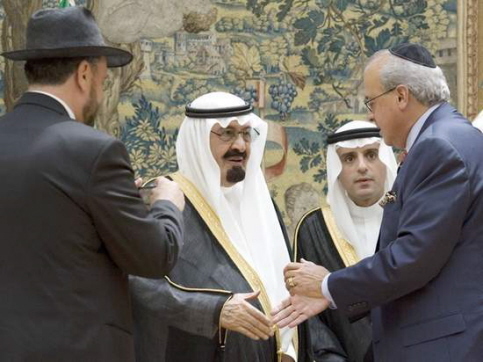
Saudi: Israel undermine any international effort for peace

on


Saudi Arabia stressed that the Israeli practices and illegal measures against the Palestinian people do not only represent a breach of the Charter of the United Nations, the humanitarian values and UN resolutions, but also undermine any international effort for peace.

In a speech before the Security Council meeting last night to discuss the situation in the Middle East, including the Palestinian issue, Permanent Representative of Saudi Arabia to the UN Ambassador Khaled Al-Nafisee called on the international community, the United Nations and especially the Quartet Committee, to follow a comprehensive strategic approach toward an immediate halt to all settlement projects in the Occupied Territories, the Saudi Press Agency reported on Friday.
Al-Nafisee said that the suffering of the Palestinian people began with the idea of giving their homeland to another people without a homeland. The issue soon spawned new issues of refugees, settlements, changing historical facts and demolition of religious sites. The Palestinian people have suffering under the brutal force of Israel with the international community not making any effective move to restrain the occupier, he pointed out.

“Had the UN Security Council carried out its role, the suffering of the Palestinian people would not have continued for more than a half a century of Israel’s worst forms of killings, displacement, imprisonment, blockade, annexation, confiscation of property and looting of goods in order to destroy that people and push them to surrender, despair and frustration through exposing them to more oppression and suffering, which is evidenced by the current Israeli practices,” the Saudi representative said.
He added that the Arabs opted for peace and not surrender and their demand has been, and still is, the implementation of the UN Security Council resolutions 242 and 338 and the principle of land for just and comprehensive peace, which requires a full Israeli withdrawal from occupied Arab territories to the 1967 borders, as well as the return of Palestinian refugees to their homes, regaining their rights, enabling the Palestinian people to exercise their right to self-determination and establishing their independent state on their national soil with Al-Quds (Jerusalem) as its capital, as well as withdrawal from the Golan Heights in Syria and the Lebanese Shebaa Farms.
He said the Israeli occupation forces that have built a wall of racist separation and expanded settlements in Palestinian territories, in addition to arming, protecting and encouraging settlers to build more settlement outposts over the past few months with simultaneous rise in incidents of demolitions of Palestinian homes, property and farms including the demolition of the historic Shepherd Hotel.
Ambassador Al-Nafisee said such practices completely hinder all peace initiatives because they surround most cities in the West Bank and make it virtually impossible to establish a contiguous and viable Palestinian state in the future.
He added that for six decades, the Arab-Israeli conflict has been and still is overshadowing all the issues in the Middle East and was a reason for the growth of extremism and terrorism and a obstacle to efforts of development and reform in that region.
At the end of his speech, the Kingdom's permanent representative at the United Nations reiterated the commitment of all Arab countries to the just and comprehensive peace based on UN resolutions. He affirmed that the commitment is still waiting for a reciprocal and serious Israeli commitment by immediately accepting the Arab Peace Initiative, which provides the only way to a lasting and comprehensive peace between the two sides.
View the original article here

Areva to sign nuke, solar deal with Saudi group

on


Top French nuclear reactor maker Areva is set to sign a partnership agreement with Saudi Arabia's Binladin Group for nuclear and solar energy, its chief executive said.
'We think that on solar thermal in Saudi Arabia there's an important market and we are partnering with Saudi Binladin Group to develop this,' Anne Lauvergeon said, without giving specific figures.
Areva is 90 per cent-controlled by the French government through direct and indirect holdings.
Top oil exporter Saudi Arabia wants to cut fossil fuel use within the next several decades, it said at an industry event where nuclear reactor maker Areva is set to sign a major deal with a Saudi partner.
Saudi Arabia wants to cut domestic oil consumption within the next several decades as it diversifies its energy mix including nuclear, Hashim Yamani, president of the King Abdullah City for Atomic and Renewables Energy, told reporters.
'You want to have an energy mix to save oil, and this oil we can leverage prices so we can sell it abroad to build these facilities,' Yamani said.
'Nuclear would be adequate for the base load, we'll use renewables to add more capacity, there are some variations -- gas and oil will have to continue to help,' he said.
Total Saudi power demand is expected to triple to 120 gigawatts (GW) by 2050 from around 40 GW in 2010, said Yamani.
'Nuclear and renewable energy will reduce dependence on fossil fuels by 2050,' Yamani said, adding that nuclear and renewable energy would free up more oil for exports.
'Saudi will need to invest upfront in nuclear energy, but the oil saved will contribute significantly to the costs.'
Given the high costs of developing nuclear energy, one rule of thumb in the industry has been that nuclear becomes a viable proposition when oil is $90 per barrel, where current prices hover around for US crude.
In 2010, Saudi consumed 3.4 million barrels per day of oil equivalent, Yamani said, but declined to comment on when the first nuclear power plant would be built. By 2028, Saudi Arabia would be consuming more than eight million boepd, he added.
There has been high interest in nuclear power on the Arabian Pensinsula.
A consortium of EDF, Areva, GDF Suez and Total lost a $40 billion nuclear deal in Abu Dhabi to a South Korean consortium in December 2009.
View the original article here

Saudi Arabia creates city for nuclear and renewable energy

on

Saudi Arabia will establish a renewable energy 'city' to meet the country's growing energy needs and reduce its dependence on fossil fuels.
King Abdullah bin Abdulaziz issued a royal decree earlier this month (17 April) ordering the creation of the King Abdullah City for Atomic and Renewable Energy (KACARE), based in Riyadh, with offshoots across the country.
KACARE will aim to contribute to sustainable development by promoting peaceful uses of atomic energy in areas such as agriculture, desalination, medicine and mining. Its work will support scientific research and development, training programmes and conferences, and co-ordination of the country's renewable energy centres.
It will be responsible for drafting a national policy on nuclear energy development, and supervising all commercial uses of nuclear power and handling of radioactive waste.
The city will be supervised by a 13-member council of representatives from relevant ministries.

Internationally, KACARE will represent Saudi Arabia at organisations such as the International Atomic Energy Agency (IAEA).
Saudi Arabia's renewable energy plans — like those of other member states of the Gulf Cooperation Council (Bahrain, Kuwait, Oman, Qatar and the United Arab Emirates) — focus on solar and nuclear energy. The council is currently preparing a regional nuclear power and desalination programme in cooperation with the IAEA.
Last month (17 March) the United Arab Emirates announced plans to establish the Gulf Nuclear Energy Infrastructure Institute, in Abu Dhabi. This educational institution will provide civilian nuclear-energy programmes in the Gulf region with a source of local nuclear-energy professionals.
Ned Xoubi, commissioner for nuclear fuel cycle at the Jordan Atomic Energy Commission, welcomed KACARE, which he sees as the first step on a "difficult and rocky road ahead that will contribute greatly to the advancement of science and technology in the Arab World".
"I am glad to finally see countries in this region realising the importance of nuclear energy, and how this cutting-edge technology will help in moving our countries into a new era, and elevate the standard of living of our people," he added.
Gamal Akabani, nuclear engineer at the Texas A&M University, United States, said: "The peaceful use of atomic energy is a right that all nations must exercise in order to create a sustainable and renewable environment".
He sees KACARE as Saudi Arabia's opportunity to lead this "massive effort" in the region by example.
View the original article here